






 Trap
 Normal
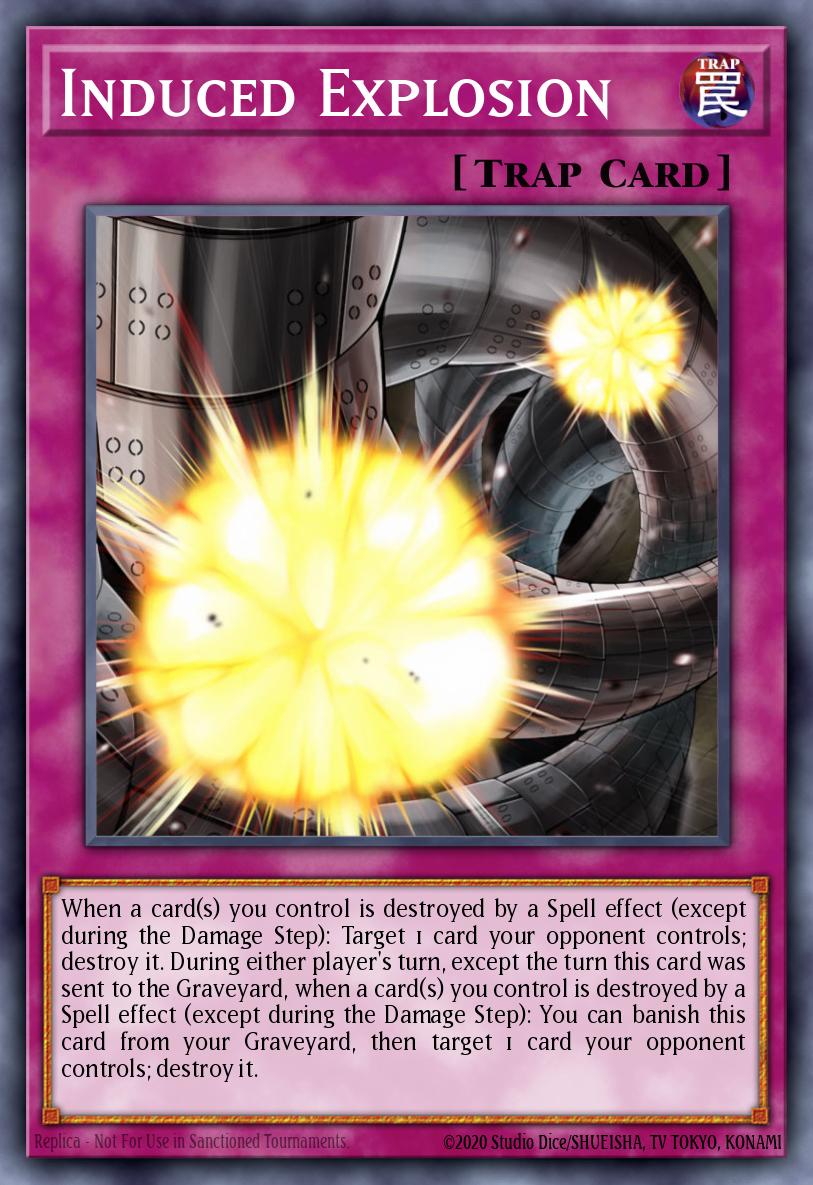
Induced Explosion
View:
3062
When a card(s) you control is destroyed by a Spell effect (except during the Damage Step): Target 1 card your opponent controls; destroy it. During either player's turn, except the turn this card was sent to the Graveyard, when a card(s) you control is destroyed by a Spell effect (except during the Damage Step): You can banish this card from your Graveyard, then target 1 card your opponent controls; destroy it.
Induced Explosion — Power Evaluation
Final Score: 50 ± 8 · Confidence: Medium
- Intrinsic: 51 · Deck: 50 · Meta: provisional
- Primary role: Removal / Negation · Secondary: Recovery/Recursion
Why it scores here
Induced Explosion is a reactive 1-for-1 removal trap whose trigger is narrow: it only fires when one of your own cards is destroyed by a Spell effect, so it is dead in most boards. The second effect, banishing it from the Graveyard to destroy another card, gives it a second use and keeps resource_economy above neutral. It has no body value and no recorded combo role, so the score comes from interaction and cost, not from high stats or popularity. The four-deck sample confirms it is run in real lists, but that reflects Infernoble and Battlin' Boxer shells rather than proven power.
Axis scores
| Axis | Score | Evidence |
|---|---|---|
| Accessibility | 35 | Set trap that needs a Spell-driven self-destruction to activate, with no searcher or enabler in the evidence (inferred; 0 combos, 4 decks). |
| Combo & Conversion | 40 | Text-only; it converts an opponent card into a destruction but builds no board of its own and has no recorded combo appearances (inferred). |
| Resource Economy | 55 | One card for one card on the first use, plus a Graveyard banish that yields a second destruction for the cost of the card itself (verified from text). |
| Effect & Interaction | 50 | Destroys one opponent card per activation, twice in total when the Graveyard effect is used; the Spell-destruction trigger limits how often that happens (verified from text). |
| Material Utility | 10 | A set trap has no material or level body and cannot be used as a Fusion, Link, or Xyz material (verified from text). |
| Resilience & Flexibility | 45 | Its value depends on being set and surviving a negate; the Graveyard effect gives a second use once it is in the Graveyard (inferred). |
| Deck-Building Efficiency | 65 | A single copy with no garnet, lock, or brick restriction; 1–2 copies per deck in the sample (observed, 4 decks). |
Calculation
Weight profile: Primary role Removal / Negation; no secondary blend applied to weights. Intrinsic ≈ 51, Deck ≈ 50, Meta = provisional. Modifiers: none. Final formula: 0.40*Intrinsic + 0.60*Deck
Strengths
- Two uses per card: once from the field or hand, and again from the Graveyard by banishing it.
- Destroys any opponent card (verified from text).
- No garnet, lock, or deck-building cost; runs at 1–2 copies (observed, 4 decks).
Weaknesses
- Trigger requires one of your own cards to be destroyed by a Spell effect, which is narrow and rarely happens on its own.
- No body, so it contributes nothing to material, boards, or the combo lines in the evidence.
- Set-trap timing limits it to reacting to a Spell effect that has already resolved.
Counters / choke points
- Negate effects that stop the Spell destruction from resolving (inferred).
- Trap-negation or bounce on the set card before activation (inferred).
Best use
Reactive removal in shells with self-destruction Spells. Decks: Infernoble Knight, Battlin' Boxer, Heros. Suggested copies: 1.
Evidence & gaps
- Verified: Card text: two effects, one destroying an opponent card on a Spell-driven self-destruction trigger and one Graveyard banish that repeats it.; Four decks run it at 1–2 copies, across four archetypes (observed).
- Observed: No recorded combo appearances, so no starter, searched, material, or payoff role is confirmed.; Gameplay split: 3 of 4 decks are one gameplay type (observed).
- Inferred: Trigger is narrow and seldom met without a Spell-driven self-destruction line.; Removal role is the best fit for a trap with this text.
- Data gaps: No combo evidence, so combo conversion is text-only. No guides supplied. No usage statistics (StatisticsCard), so inclusion is inferred from the four-deck sample only. No banlist token; assumed 3 copies (unlimited). The race field reads Normal, which is not a real trap attribute; ignored for scoring.